
The Oldest Surviving Document in Icelandic

When people think about ancient texts in Icelandic, they usually imagine sagas. They think of heroic narratives, skaldic poetry, pagan mythology, or perhaps the Edda of Snorri Sturluson. Medieval Iceland is often remembered primarily as a society of storytellers, poets, and historians, an isolated literary culture at the edge of Europe producing some of the most remarkable vernacular prose of the Middle Ages. Yet the oldest surviving document written in Icelandic is none of the things one may think.
It is not a saga. It is not a poem. It is not even a literary text: The oldest surviving witness to the Icelandic language that is more securely datable is instead a church inventory known as Reykjaholtsmáldagi, the deed or inventory of the church at Reykjaholt (today’s Reykholt) in Borgarfjörður, western Iceland.
At first glance, this may sound disappointingly mundane. But in reality, it reveals something profound about how literacy first emerged and functioned in medieval Iceland. Before Icelandic became the language of sagas and historical prose, as it was often the case, it became a language of administration, law, property, and ecclesiastical memory.
The survival of Reykjaholtsmáldagi allows us to observe the Icelandic language at an extraordinarily early stage, still in the process of defining its written conventions, while simultaneously opening a window into the social, religious, and intellectual world of medieval Iceland during and before the age of Snorri Sturluson.
What Is a Máldagi?
The Old Icelandic word máldagi roughly means a deed, inventory, or formal record. Collections of this kind of documents are technically called cartularies. Medieval churches in Iceland maintained such documents in order to record their possessions, rights, obligations, and income.
A máldagi could include information such as details on land ownership and property boundaries, livestock, fishing rights, driftwood rights, beached whales, books, bells, vestments, relics, chalices, donations and other movable or immovable property. These documents were not static. They were updated whenever churches acquired new property or privileges. The bishop visiting a church might also produce or revise his own copy during episcopal inspections.
The existence of a document like Reykjaholtsmáldagi presupposes scribes, parchment production, documentary practices, legal traditions, episcopal administration, and a society integrated into the wider culture of Latin Christendom.
Reykholt Before and During Snorri’s Time
Today Reykholt is associated almost entirely with Snorri Sturluson: Visitors come to see Snorralaug, the hot spring bath traditionally associated with him, and to encounter the memory of one of the most influential writers and political figures in medieval Scandinavia. Yet Reykholt was already an important ecclesiastical and cultural centre even before Snorri acquired the estate. The máldagi belongs precisely to this world.
The earliest section of the document appears to date from the second half of the twelfth century. The second section mentions Snorri, who is known to have moved to Reykholt no later than 1208, meaning that earlier section must have been written before. Other additions continued to be made throughout the thirteenth century, meaning that the document spans several generations of Reykholt’s history.
Some entries appear directly connected to the social environment surrounding Snorri himself. The text mentions figures known from Sturlunga saga, including Hallveig Ormsdóttir, Snorri’s wealthy companion during the final years of his life. One section was probably written after Hallveig came to Reykholt around 1224.
A Single Leaf from a Lost Manuscript
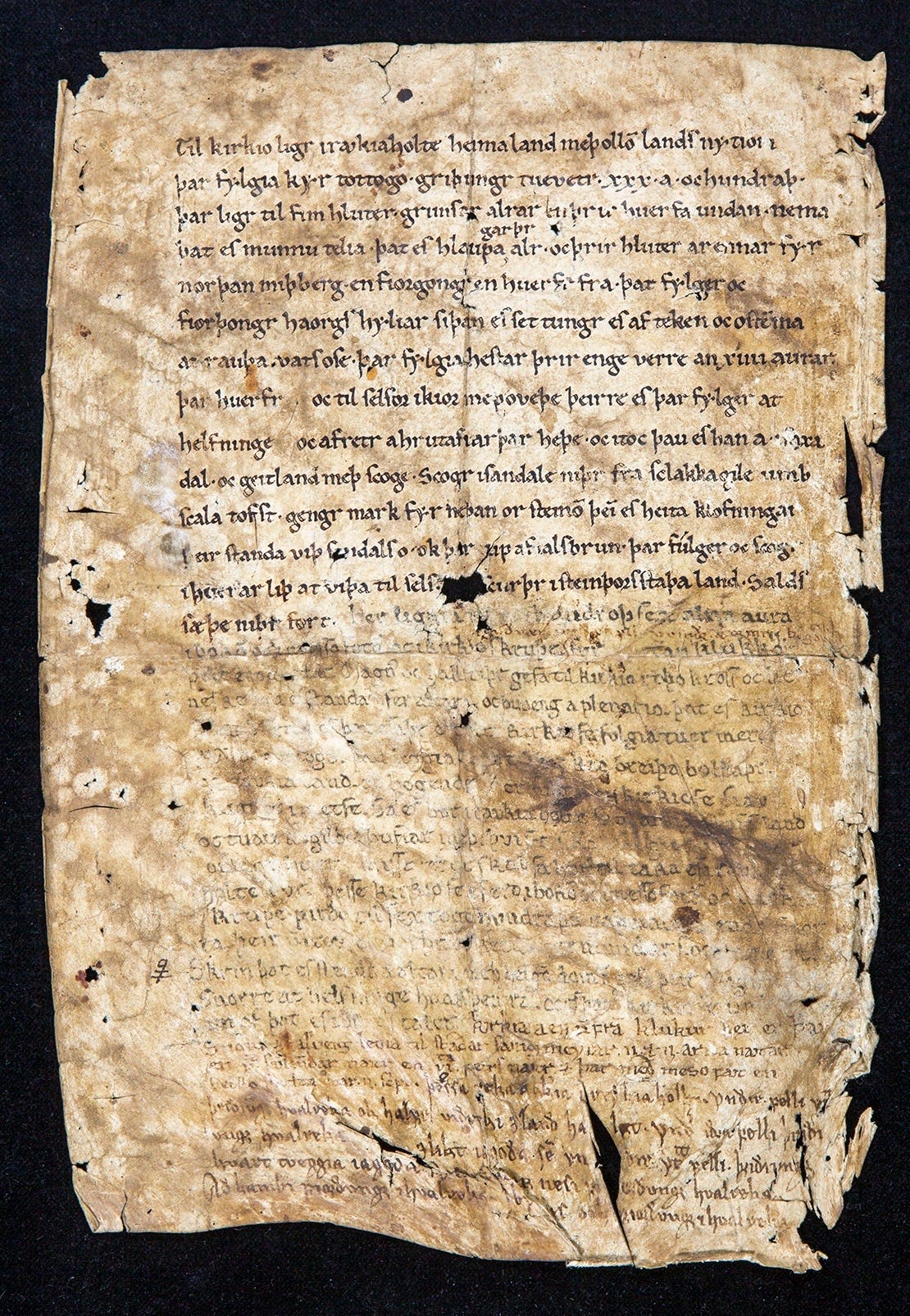
One of the most remarkable aspects of Reykjaholtsmáldagi is its physical form. The entire surviving document consists of a single parchment leaf that once belonged to a larger codex now lost. The original manuscript may have contained homilies, liturgical material, or saints’ lives. At some point, an empty page was used to record the church inventory. This was not unusual in medieval Iceland.
Blank flyleaves and unused pages in ecclesiastical manuscripts were often repurposed for practical administrative texts. Parchment was expensive, and unused space was valuable. Over time, new additions were inserted into the document by different scribes. Rather than a unified composition, the manuscript gradually became a layered accumulation of historical moments.
Modern scholars divide these sections into several different scribal hands, usually designated R1 through R7. The oldest portion, R1 (lines 1–14), is generally dated somewhere between about 1150 and 1200, and constitutes the earliest layer of the document.
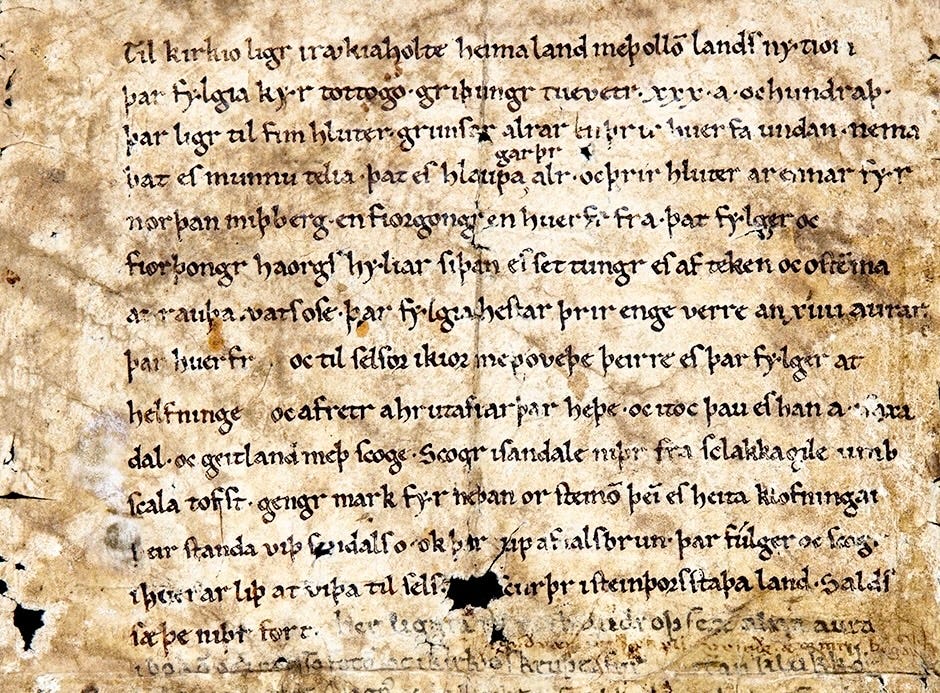
A second section, R2 (lines 14–29), was likely added between approximately 1204 and 1208, around the period when Snorri Sturluson took over Reykholt. R3 (lines 29–32) belongs to the years between 1224 and Snorri’s death in 1241, while R4 (lines 32–36) appears to date from around 1300 and reflects a noticeably later scribal hand and orthographic stage. The reverse side of the leaf preserves further additions: R5, written in four lines in the first column, probably belongs to the later thirteenth century, whereas R6, another short note in the adjacent column, is dated roughly to 1224–1241. Finally, scholars identify an interpolated line inserted between lines 14 and 15, labelled R7, which was probably added between 1242 and 1247.
The result resembles a stratified archaeological site more than a conventional literary manuscript. Different centuries coexist on the same sheet of vellum. Even the layout of the parchment reflects this gradual growth. Later additions were squeezed into margins and remaining spaces. Sections on the reverse side were written in narrow columns fitted around existing material. The document evolved organically through use.
The Earliest Icelandic Language
The linguistic importance of Reykjaholtsmáldagi can scarcely be overstated. It is among the oldest surviving documents written in Icelandic, and possibly the oldest substantial vernacular witness preserved on Icelandic soil. Another possible contender for the title of oldest surviving Icelandic document survives in two damaged leaves now preserved as AM 237 a fol., containing homiletic material (sermons). Unlike the Reykjaholtsmáldagi, however, these leaves cannot be dated through securely identifiable historical individuals or events. Their dating relies entirely on internal evidence, principally palaeography and linguistic features, which inevitably allows for a much broader chronological margin of error. Scholars have traditionally them somewhere between roughly 1125 and 1175.
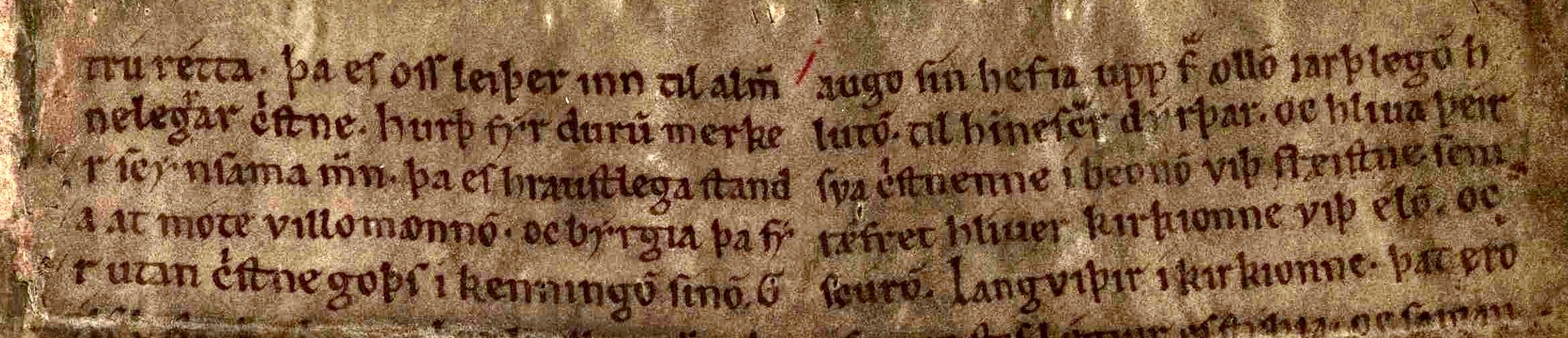
The handwriting of AM 237 a fol. is strikingly similar to that of the oldest section of Reykjaholtsmáldagi, although some orthographic conventions differ. Scholars have provided a few possible explanations for this. The sermons may have been copied by the same scribe from an older exemplar preserving earlier conventions; alternatively, the two manuscripts may have been written by different scribes trained within the same milieu or scriptoria tradition. A closer look at the orthography, however, reveals differences that are too substantial for the idea of a single scribe to be tenable. R1 uses less abbreviations and all in all has a more archaic character.
Around the middle of the twelfth century, an anonymous scholar conventionally known as the First Grammarian composed a remarkable treatise proposing a standardised orthography for the Icelandic language which we call First Grammatical Treatise. His system attempted to adapt the Latin alphabet to the far richer vowel inventory of Old Icelandic by introducing additional characters such as <ø>, <ę> and <ǫ>. He also proposed the use of small capital letters to represent long consonants that were otherwise written with doubled letters, such as <ᴅ>, <ᴍ> and <ʀ>. These reforms were never adopted systematically, but many Icelandic scribes incorporated some of the First Grammarian’s innovations, often inconsistently and alongside older spelling conventions.
Interestingly, the scribe responsible for R1, the oldest layer of Reykjaholtsmáldagi, appears to show relatively little influence from these orthographic reforms, whereas the scribe of AM 237 a fol. adopts some of them much more readily. This may suggest that R1 predates not only the surviving sermon leaves, but perhaps even the composition or wider circulation of the First Grammatical Treatise itself. But how much earlier could it be?
During the winter of 1117–1118, Icelanders undertook the task of committing their laws to writing for the first time, producing the legal code later known as Grágás. Some years later, a Christian law section was added to the code.Old manuscripts preserving the Christian law section of Grágás contain a revealing passage stating that
“Bishop Ketill and Bishop Þorlákr established the Christian Law Section in consultation with Archbishop Össur, Sæmundr, and many other clerics.”
These references allow the text to be dated with unusual precision. Bishop Þorlákr Þórhallsson of Skálholt was consecrated in 1118 and died in 1133, while Bishop Ketill Þorsteinsson of Hólar returned to Iceland after his consecration in 1122 . The scholar and chieftain Sæmundr Sigfússon, one of the most prominent intellectual figures in early twelfth-century Iceland, also died in 1133. Since all three are mentioned together as participants in the formulation of the Christian law code, the legislation must have been enacted sometime between 1122 and 1133, when all of them were both alive and in Iceland.
This Christian law section of Grágás included a provision requiring the custodians of churches to maintain inventories of ecclesiastical property. Since Reykjaholtsmáldagi was almost certainly produced within this administrative framework, the oldest layer of the manuscript was probably written after the promulgation of that legislation. If this reasoning is correct, R1 may plausibly date somewhere between roughly 1130 and 1150, which would make it the oldest surviving document written in Icelandic.
This does not mean Icelanders had not written earlier texts. They certainly had. But earlier manuscripts have largely disappeared. The survival of ancient texts is not necessarily fully representative of what once existed. It is the result of accidents, institutional priorities, climate, material reuse, neglect, fire, and historical chance. What survives from the earliest phases of Icelandic writing is also fragmentary. For instance, what must have been a very abundant production of Latin manuscripts has only survived in scattered fragments.
The language of the máldagi itself preserves Icelandic in a comparatively unstable orthographic phase. Modern Icelandic spelling, though artificially conservative is now strictly standardised, but medieval scribes were continuously negotiating how best to adapt the Latin alphabet to a North Germanic vernacular with a much richer vowel system which, to add to the difficulty, was also constantly evolving like all languages do. Because of this, the manuscript preserves fluctuating spellings and competing graphic systems.
Some sections use older conventions associated with earlier Icelandic writing. Others reveal developments in pronunciation and orthography that would later become standard. Certain passages preserve evidence of monophthongisation, while others reveal uncertainty regarding vowel representation. For example, the first two hands mostly spell the unstressed /ɪ/ and /u/ vowel as “e” and “o”, but occasionally as “i” and “u”. The second hand uses the insular letter “ƿ“ (which entered Icelandic after the beginning of the thirteenth century) alongside “v” and “u”, while the first hand only used “v” and “u”. The third hand confuses “d” and “ð” before -n, which shows a development happening in the language at that time. The document therefore captures Icelandic as a developing written system.
Caroline Minuscule and the Coming of Gothic Script
The manuscript is equally important from a palaeographical perspective. The earliest sections are written in the so-called Caroline minuscule, the script that dominated much of Western Europe from the period of Charlemagne until the development into the Gothic script. This immediately situates Iceland within a broader European scribal tradition. Medieval Icelandic writing did not emerge in isolation. It developed within the intellectual and ecclesiastical structures of Latin Christendom. Later sections of the máldagi begin to show Proto-Gothic and Gothic tendencies:
letters become taller and narrower,
spacing becomes denser,
rounded Caroline forms gradually disappear.
Within a single parchment leaf, one can therefore observe the evolution of medieval handwriting traditions over time. This transformation mirrors developments occurring elsewhere in Europe.
Survival Through Catastrophe
That Reykjaholtsmáldagi survives at all is almost miraculous. The codex to which the parchment originally belonged eventually disappeared, probably during the upheavals surrounding the Reformation and the centuries that followed. Manuscripts that were associated with the Catholic Church suffered enormously in post-Reformation Iceland. Liturgical books and other texts in Latin were often neglected, dismantled, recycled into bindings, or simply discarded. Vellum itself remained valuable material, and old manuscripts were frequently cut apart for practical reuse.
Neglect, therefore, had an impact on the poor preservation of the document. By the sixteenth century, people were already complaining that the document was difficult or impossible to read: A legal reference from 1562 reports judges stating that they had been presented with a máldagi from Reykholt during a court case, but that they could not properly decipher it.
Árni Magnússon and the Rescue of Icelandic Memory
The later history of the document belongs to the great age of Icelandic antiquarian scholarship. No figure looms larger here than Árni Magnússon. Árni collected manuscripts on a scale almost impossible to exaggerate. Through copying, commissioning transcripts, and rescuing damaged codices, he preserved enormous portions of medieval Icelandic culture that might otherwise have vanished forever.
Reykjaholtsmáldagi entered this antiquarian world of transcription and philological analysis during the seventeenth and eighteenth centuries. Various copies and editions were produced:
episcopal transcripts,
official copies,
antiquarian reproductions,
and eventually nineteenth-century scholarly editions in Diplomatarium Islandicum and Íslenzkt fornbréfasafn.
Scholars debated the chronology of the different hands and attempted to reconstruct the history of the manuscript layer by layer. What had once been a practical church inventory gradually became recognised as one of the foundational documents of Icelandic linguistic history.
References
Guðvarður Már Gunnlaugsson, ed. Reykjaholtsmáldagi. Preface by Bergur Þorgeirsson. Translation of the máldagi by Margaret Cormack. Reykholt: Reykholtskirkja – Snorrastofa, 2000.
Guðvarður Már Gunnlaugsson. “The Deed of the Church of Reykholt”. Snorri Sturluson and Reykholt. The Author and Magnate, his Life, Works and Environment at Reykholt in Iceland. Eds. Guðrún Sveinbjarnardóttir and Helgi Þorláksson. Museum Tusculanum Press in collaboration with The Institute of History, University of Iceland, and Snorrastofa at Reykholt, Copenhagen, 2018. Pp. 279–289
Diplomatarium Islandicum: Íslenzkt fornbréfasafn, sem hefir inni að halda bréf og gjörninga, dóma og máldaga, og aðrar skrár, er snerta Ísland eða íslenzka menn. Vol. 1, 834–1264. Kaupmannahöfn: Hið íslenzka bókmentafélag, 1857–1876.