

The Icelandic fiðla

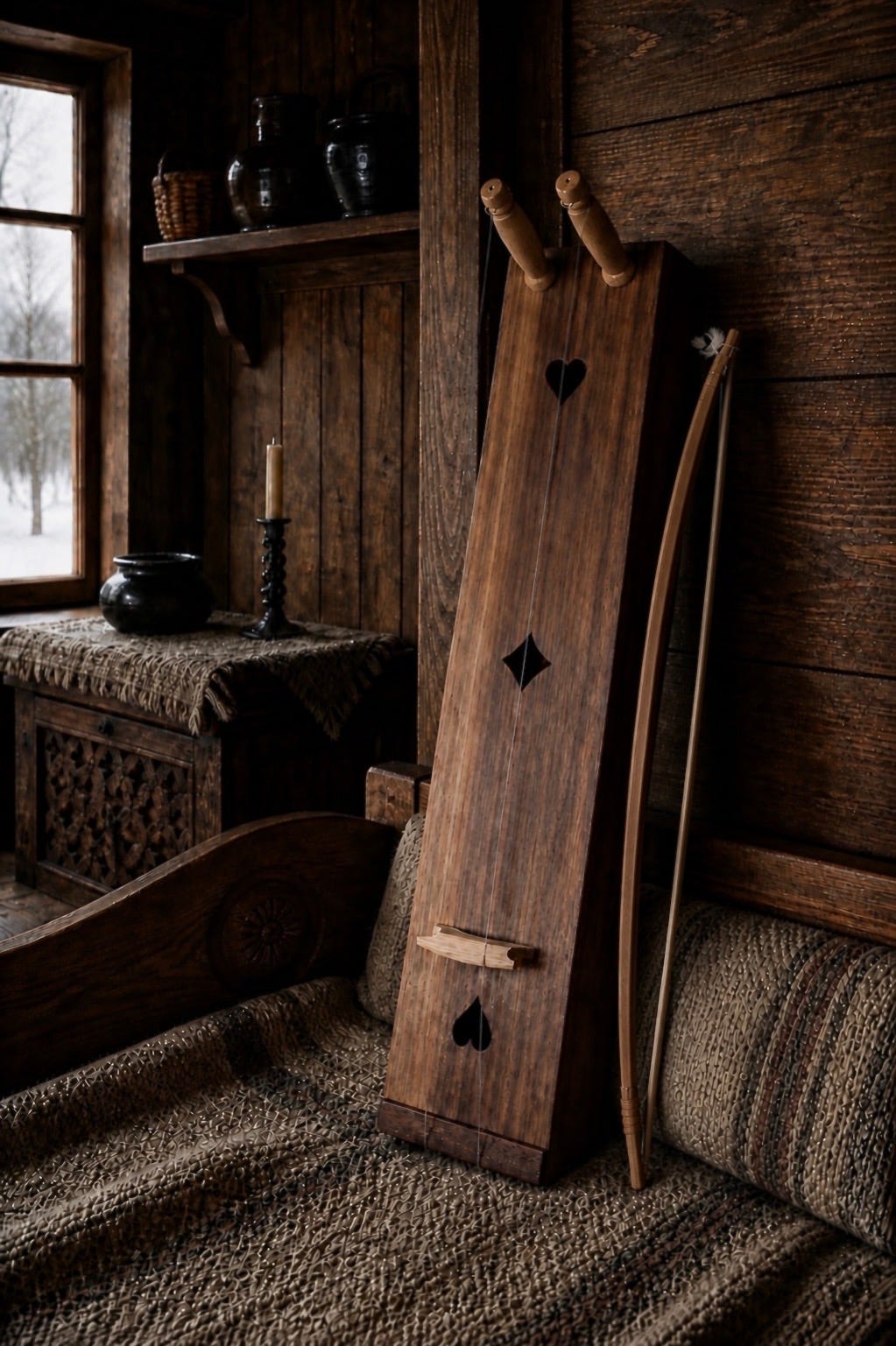
Thinking about Iceland today, and its musical landscape, one is immediately struck by the prominence of world-renowned performers, often perceived as innovative, unconventional, and distinctive. For those familiar with Icelandic music, the country appears as a place saturated with sound: concerts, festivals, and a vibrant network of ensembles and artists. This image, however, is relatively recent.
Until well into the twentieth century, the Icelandic musical sphere was structurally limited, not for lack of musical sensibility, but for the scarcity of instruments and the narrow range of available performance contexts. Most music was sacred in nature, and the instrumental resources were minimal. Apart from a small number of harmoniums imported from abroad, musical practice relied almost entirely on two local traditions: the langspil and the instrument that will concern us here, the so-called “Icelandic violin”, or fiðla.
It is precisely against this background of material simplicity that the fiðla must be understood. Far from being a marginal curiosity, it represents one of the few tangible expressions of a broader, largely undocumented instrumental culture, whose apparent poverty conceals a far more complex history of adaptation.
This is a traditional Icelandic instrument. In modern Icelandic, fiðla refers to the standard violin, a term cognate with English fiddle, which in folk contexts designates the same instrument also known as the violin. The traditional instrument discussed here is therefore more precisely called íslensk fiðla, literally “Icelandic violin”.
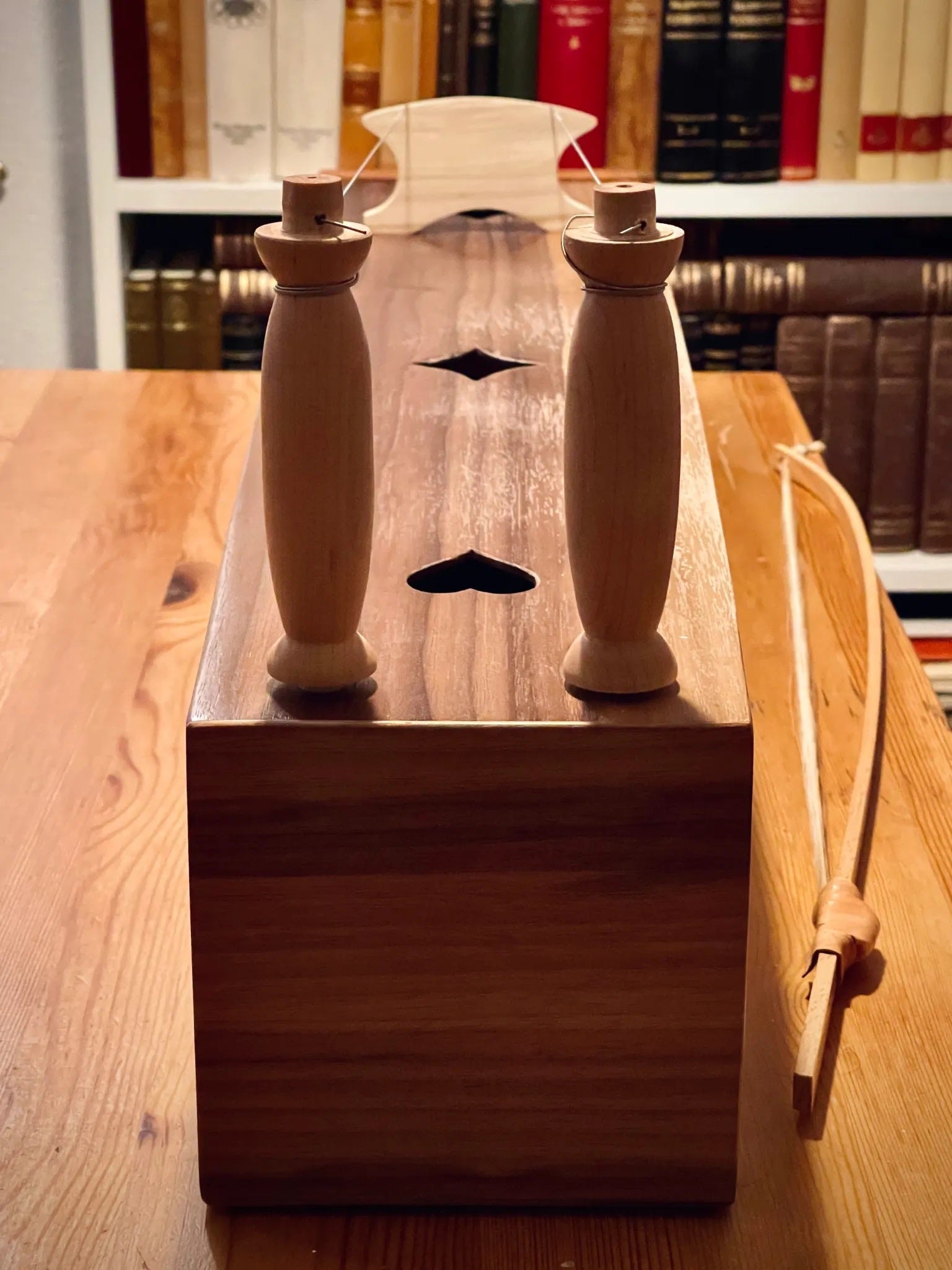
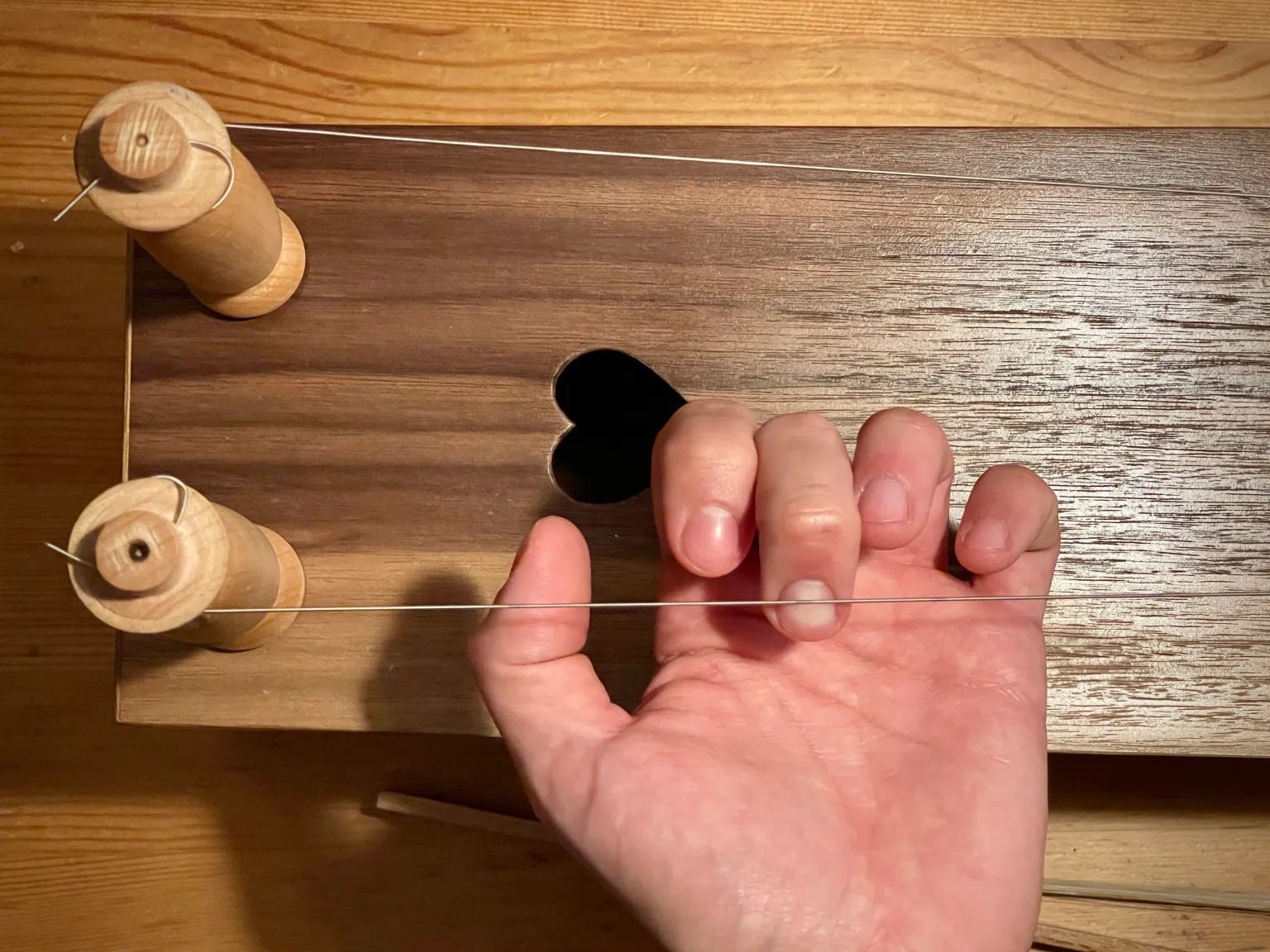
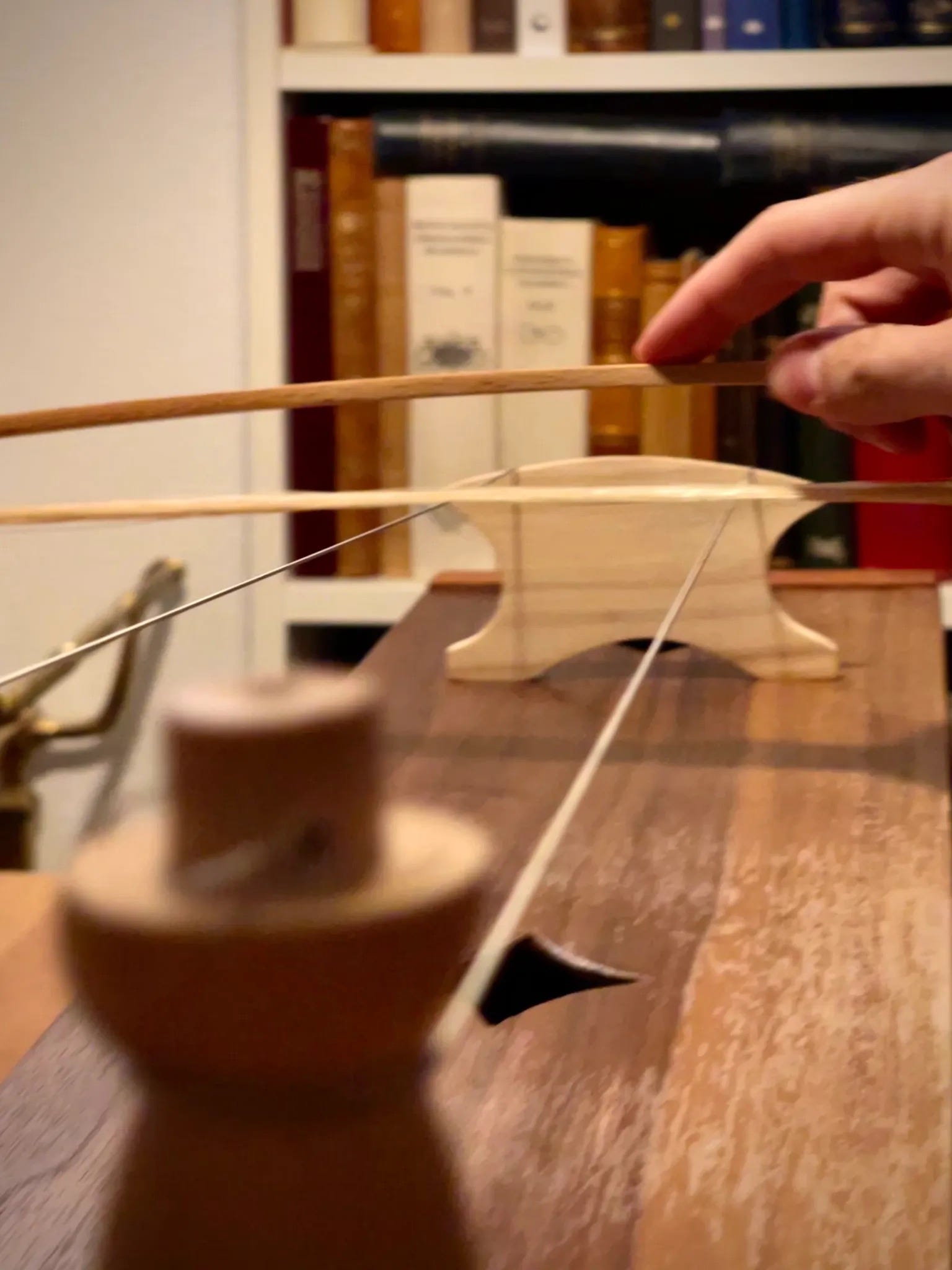
Despite the name, the íslensk fiðla does not belong to the same lineage as the classical violin. It is played with a bow, but the manner in which the strings are stopped differs fundamentally. Rather than being pressed down against a fingerboard with the fingertips, the strings are touched from below with the fingernails, the palm of the hand facing upwards. This position is not an idiosyncratic stylistic choice, but a structural necessity, linked to the low tension of the strings, originally made of horsehair, and to the absence of a developed fingerboard in the modern sense.
A plausible reconstruction would place the instrument within a broader family of simple bowed chordophones, closer in principle to bowed lyres than to later European violins. The technique itself, unusual from the perspective of Western art music, reflects a different set of constraints and possibilities, and contributes directly to the characteristic instability of pitch and timbre that defines the instrument’s sound.
History
The history of the Icelandic violin is notoriously difficult to reconstruct. Bowed string instruments of a relatively simple kind are attested from an early period, and references to such instruments appear in some of the earliest Norse sources. The problem, however, is not the absence of terminology, but its ambiguity: the word fiðla occurs in ancient sources, yet it cannot be assumed to denote a stable or clearly defined organological type across time.
The Danish musicologist Hortense Panum proposed that the langspil was introduced into Iceland from Norway, where a related plucked instrument, the langeleik, is attested. Its origins are obscure, though it may ultimately derive from a monochord-type instrument of classical antiquity. According to Panum, the langspil would only later have adopted bowing technique, under the influence of an already existing Icelandic bowed instrument, which would imply that the fiðla predates it in functional terms.
This argument rests partly on structural considerations. Early forms of the instrument are described as consisting of a hollowed soundbox, possibly without a back, strung with one or two horsehair strings. Such features suggest a construction that relies on minimal materials and simple techniques, consistent with an early stage of development. A plausible reconstruction would therefore envisage an instrument fashioned from a hollowed piece of wood, with a small number of strings stretched across it, prior to any later refinements.
At the same time, Panum herself emphasised the limits of the available evidence, explaining that it is not possible to push the development of this instrument earlier than the sixteenth century with the available evidence, despite a much earlier date being extremely plausible. Although earlier textual sources do mention the name fiðla, there is no secure basis for identifying these references with the instrument as later described. The mere recurrence of a term does not guarantee continuity of form. In this respect, the situation is analogous to the use of food names in literary sources: when Giovanni Boccaccio refers to “Parmesan”, it does not necessarily follow that the product in question corresponds to what is today understood by that name. Indeed, today’s Parmesan was standardised starting from the last quarter of the twentieth century!
To give an example, a frequently cited passage occurs in chapter 22 of the Ynglinga saga, preserved within Heimskringla by Snorri Sturluson (c. 1200). There it is reported that the Swedish king Hugleikur maintained a retinue that included actors, harpists, and fiðlarar, conventionally translated as “violinists”. The term, however, must be treated with caution. It signals the presence of bowed or string-playing specialists, but tells us little about the precise nature of the instruments involved. To read it as evidence for the existence of an instrument of the same name familiar to us would clearly be anachronistic. The occurrence of fiðla establishes the presence of a category of instruments, not the identity of a specific form. It is nonetheless possible that the instruments implied by such references belonged to the same broader family as the later Icelandic fiðla, even if direct continuity cannot be demonstrated.
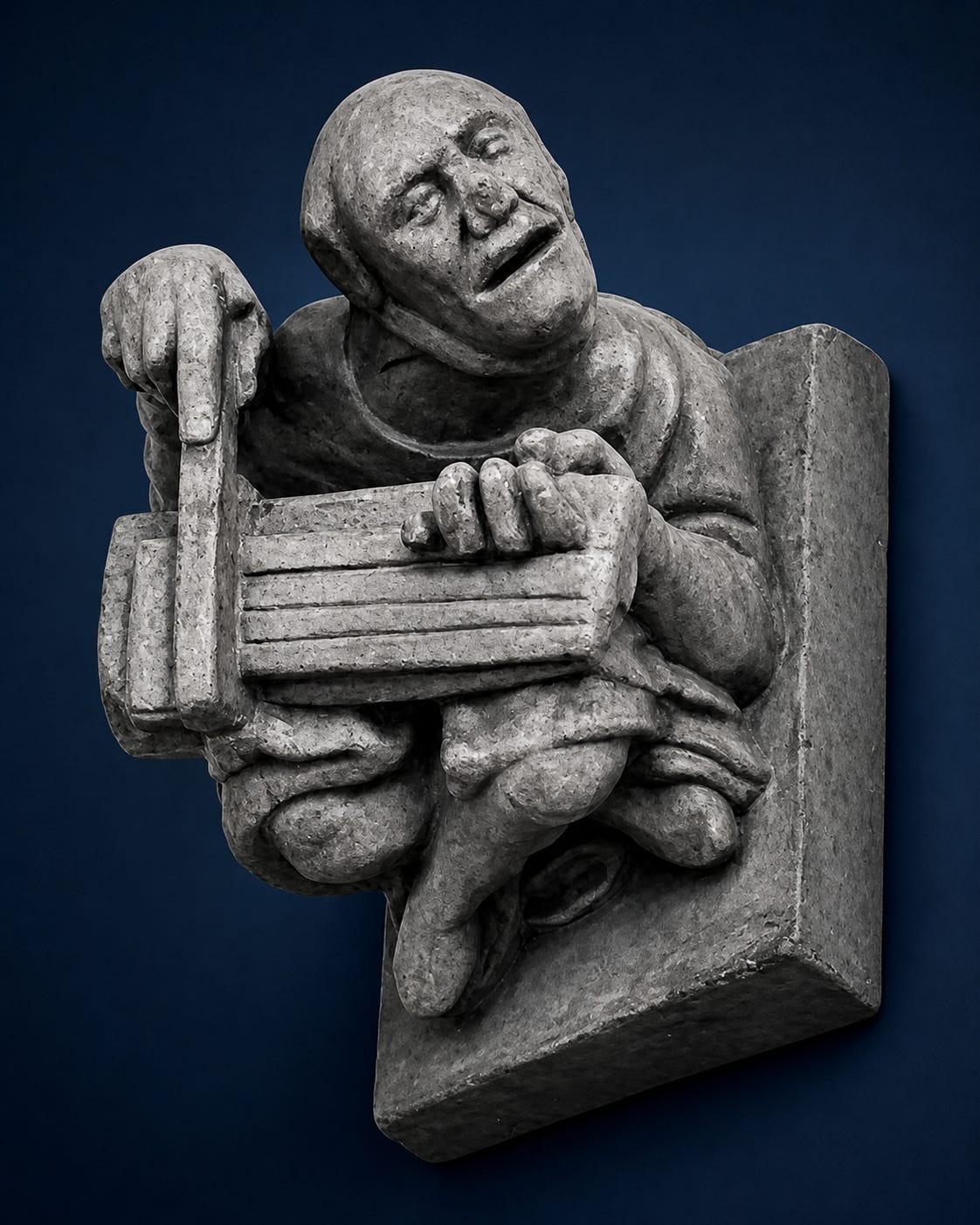
Material evidence has also been brought into the discussion. A twelfth-century relief in the cathedral of Nidaros Cathedral in Trondheim (Norway) appears to depict a bowed string instrument of relatively simple construction. The identification remains uncertain, yet the image has attracted attention precisely because of its apparent similarity to later northern European bowed instruments.
Building on such material, Otto Andersson proposed that this type of instrument developed from a bowed harp or lyre introduced into northern Europe from Ireland through contact with Gaelic Christianity. Within this framework, the Icelandic fiðla could be interpreted as a relatively conservative survival of an earlier stage in this developmental line, whereas in mainland Scandinavia comparable instruments would have undergone further structural elaboration. This would be paralleled by the survival in Iceland, at the European periphery, of the medieval two-voice organum, the tvísöngur, which was practiced in Iceland until the nineteenth century, while abandoned in the Middle Ages elsewhere in Europe.
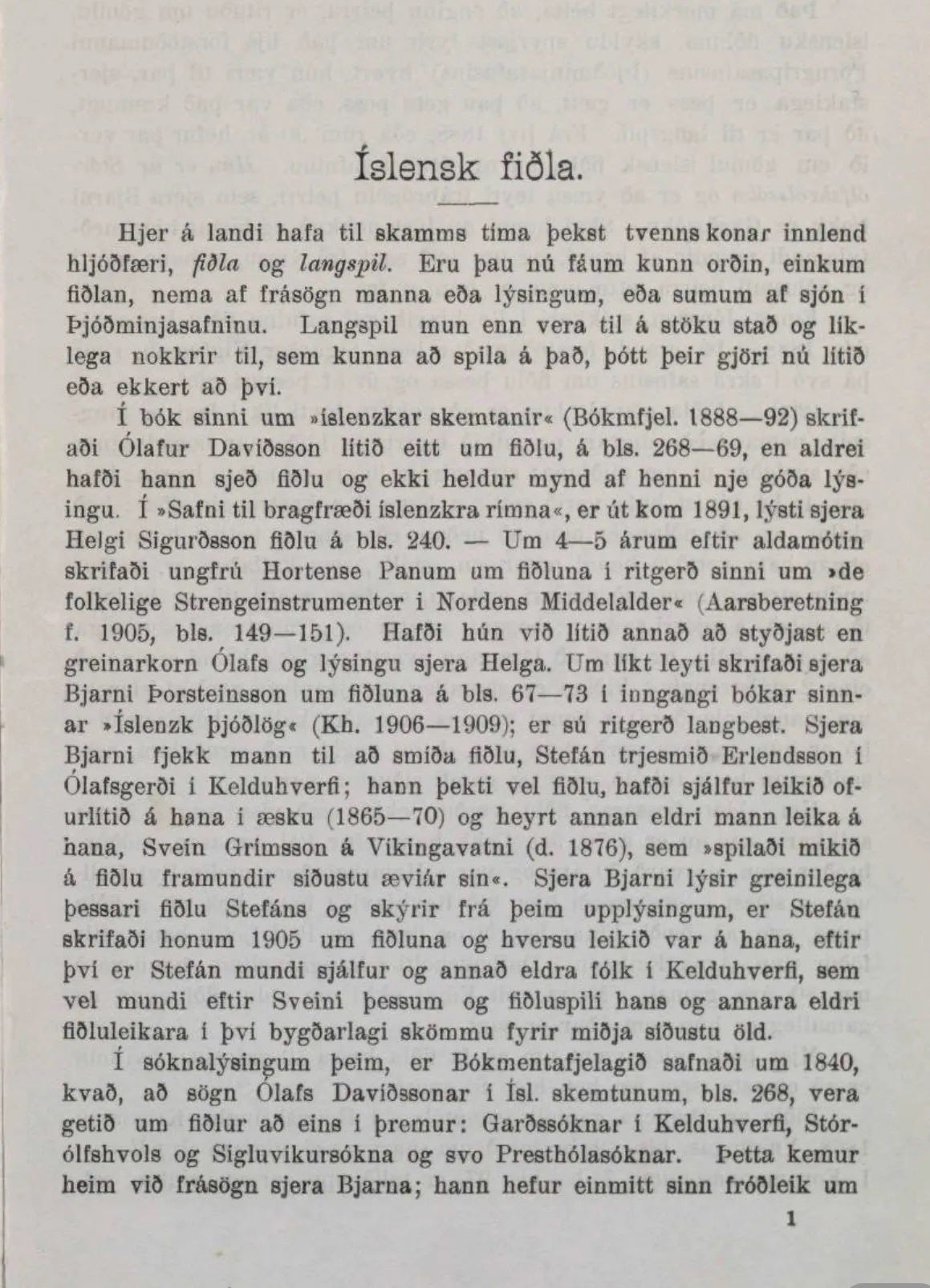
Such an interpretation aligns with a broader pattern often observed in peripheral regions, where older forms may persist longer, less subject to the pressures of standardisation and technical innovation that tend to operate more strongly in cultural centres. Matthías Þórðarson, in his 1919 article, maintains that the extreme simplicity of the fiðla would support the idea of it having a very ancient origin.
A different type of evidence is provided by later narrative traditions. One such account, set around the sixteenth century, concerns a musician known as fiðlu-Björn (Violin-Björn), said to have been from Skagafjörður in north-western Iceland. According to the story, he travelled from farm to farm, performing for local communities. The narrative, however, belongs to the realm of legend rather than verifiable history, and must be approached as such.
Within this account, a symbolic distinction is drawn between instruments. When Björn played the langspil, he was said to be visited by angels; when he played the fiðla, elves and other spirits gathered around him. The opposition is suggestive, though not entirely clear. The instrument itself is not described in detail, and it remains uncertain whether the fiðla referred to here corresponds to the instrument of the same name or to a more generic category of bowed strings.
A further episode relates that, having lost his way in the fog, Björn sought shelter beneath a rock and began to play in order to pass the time. After a while, he heard a voice from within the stone reciting a poem, which was later attributed to him. The text reflects a moralising and contemplative tone consistent with Icelandic poetic traditions:
Mér verður fuglsins dæmi / sem fjaðralaus kúrir
“I take the bird as my example,
that huddles, stripped of feathers,
slipping swiftly into shelter,
withdrawing from the storm.
It loses its song and its motion,
its joy diminished.
So too does each greet another at dawn,
bowed beneath the weight of hardship.”
While the historical value of such accounts is limited, they are nonetheless significant in that they attest to the cultural presence of bowed instruments within a wider imaginative and symbolic framework.
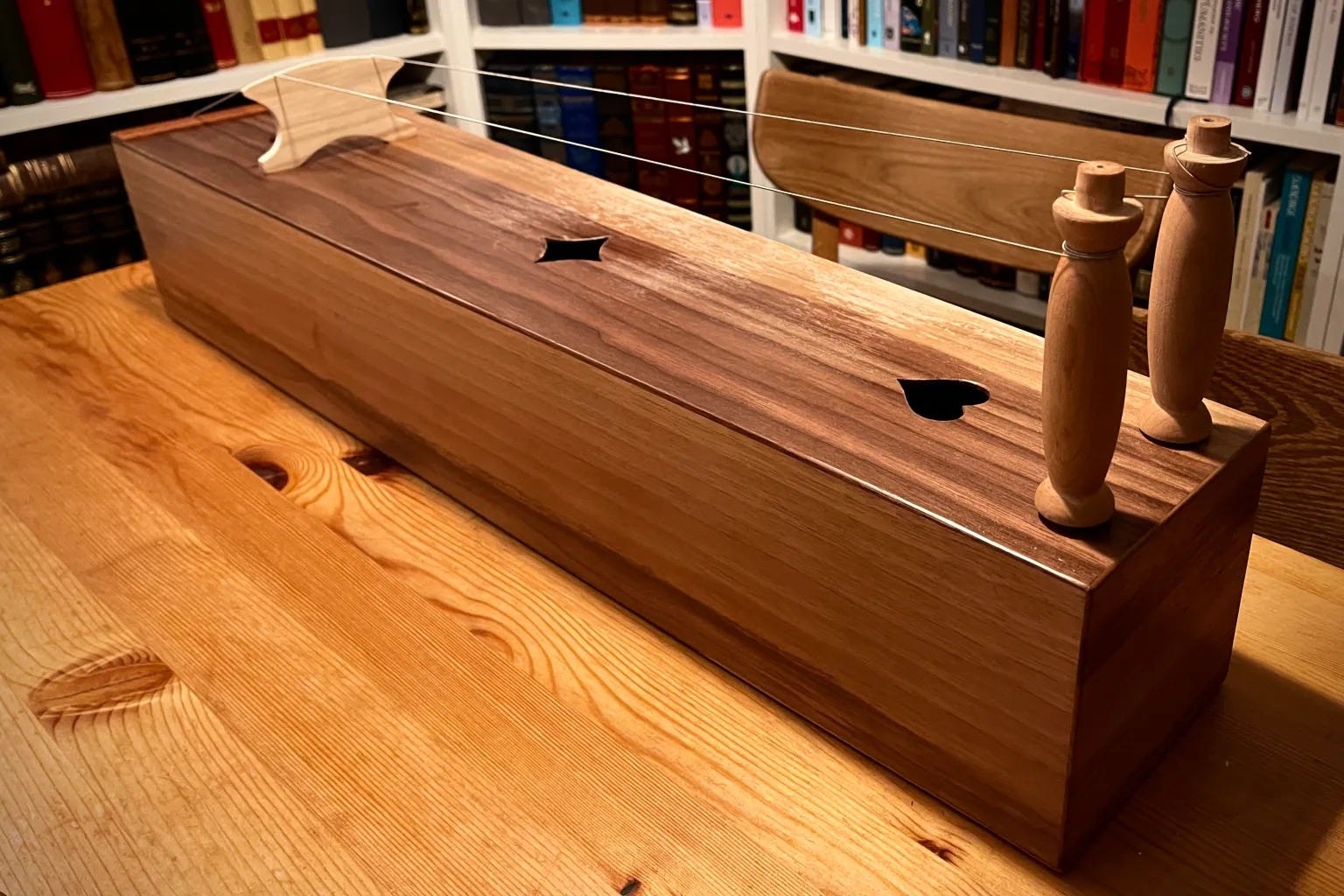
More secure evidence emerges in the eighteenth century. An Icelandic–Latin dictionary compiled by Jón Ólafsson of Grunnavík appears to provide the first reliable description of the fiðla in a form recognisable today. It is defined as a musical instrument with two strings made of horsehair, played with a bow:
instrumentum musicum duabus chordis e pilis equinis et quidem nigris instructum. Arcus autem unicum habet funiculum, qui carbone vel Calfonio attritus, acriorem in chordis edit sonum.
“A musical instrument equipped with two strings made of horsehair, indeed black. The bow has a single string which, when rubbed with resin, produces a sharper sound on the strings.”
Several elements of this description are noteworthy. The use of horsehair for both the strings and the bow points to a low-tension system, quite unlike that of later European violins with gut or metal strings. Equally significant is the explicit mention of resin (calfonium), applied to the bow in order to increase friction and improve sound production.
This detail is particularly instructive. It has sometimes been suggested that such techniques would have been impractical in Iceland due to the absence of suitable materials. Yet the reference to resin indicates that, although it must necessarily have been an imported commodity, it was nevertheless available and in use. It also suggests a level of technical awareness that goes beyond the most rudimentary forms of instrument-making.
From the eighteenth century onward, both local descriptions and accounts by foreign travellers become more numerous and more precise, allowing the instrument to be described with greater confidence. Among these, the account provided by the priest Bjarni Þorsteinsson, author of the extensive collection Íslensk þjóðlög, is particularly detailed.
He describes the instrument in essentially the same form in which it is known today: two strings tuned in unison, tightened “as high as possible without the string breaking”. The string closest to the player serves for the melody, while the second likely functions as a drone, providing a continuous tonal reference. This configuration places the instrument within a wider family of pre-modern musical practices in which the interplay between melody and drone is structurally central.
Later descriptions mention variations in construction, including soundboxes without a back and, in some cases, instruments with four strings. As with the langspil, such evidence suggests that no single standardised form existed, but rather a range of locally adapted variants. Over time, the original horsehair strings were replaced by metal ones, probably under the influence of developments associated with the langspil.
During the nineteenth century, the fiðla gradually fell out of use, supplanted by the more versatile langspil, which offered greater flexibility in tuning and melodic execution. Toward the end of the twentieth century, however, the instrument experienced a modest revival and is now occasionally employed in the performance of traditional songs and within folk ensembles.
Technique
The technique of the instrument reflects its structural simplicity. The right hand draws the bow across the strings, while the left hand modifies the pitch of the melodic string by bringing it into contact with the fingernails at different points along its length, from below. Unlike the violin, there is no developed fingerboard against which the string is firmly stopped; instead, pitch is controlled through light contact, often involving more than one fingernail when intervals are close.
This method of sound production has direct acoustic consequences. The low tension of the strings, combined with the absence of firm stopping, results in a tone that is inherently unstable, both in pitch and in timbre. To modern ears, accustomed to the precision and clarity of the classical violin, the sound may appear rough or even unrefined. To me it could be compared to a poorly tuned cello.
Yet such judgements are largely a matter of perspective. What may be perceived as a lack of refinement can equally be understood as the audible trace of a different set of priorities and constraints. The fiðla does not aim at technical brilliance or expressive range in the modern sense; rather, it preserves a mode of sound production rooted in material economy and functional simplicity.
It is precisely this quality that gives the instrument its particular expressive force. The fiðla evokes a world that is markedly distant from contemporary musical expectations, one shaped by limited resources but sustained by continuity of practice. In this sense, it stands not merely as an isolated curiosity, but as a rare and tangible survival of a broader instrumental culture, largely lost, yet still perceptible in its most elemental form.
Sources:
Andersson, Otto. The Bowed Harp of Trondheim Cathedral and Related Instruments in East and West. Stockholm, 1970.
Matthías Þórðarson. “Íslensk fiðla.” Árbók hins íslenska fornleifafélags (1919).
Panum, Hortense, and Jeffrey Pulver. Stringed Instruments of the Middle Ages: An Illustrated History Guide. Fairhaven Press and The String Music Archaeology Project, 2018. (First published 1940; revised editions 1971 and 2018.)