

No, Icelandic is not difficult. Stop saying it.

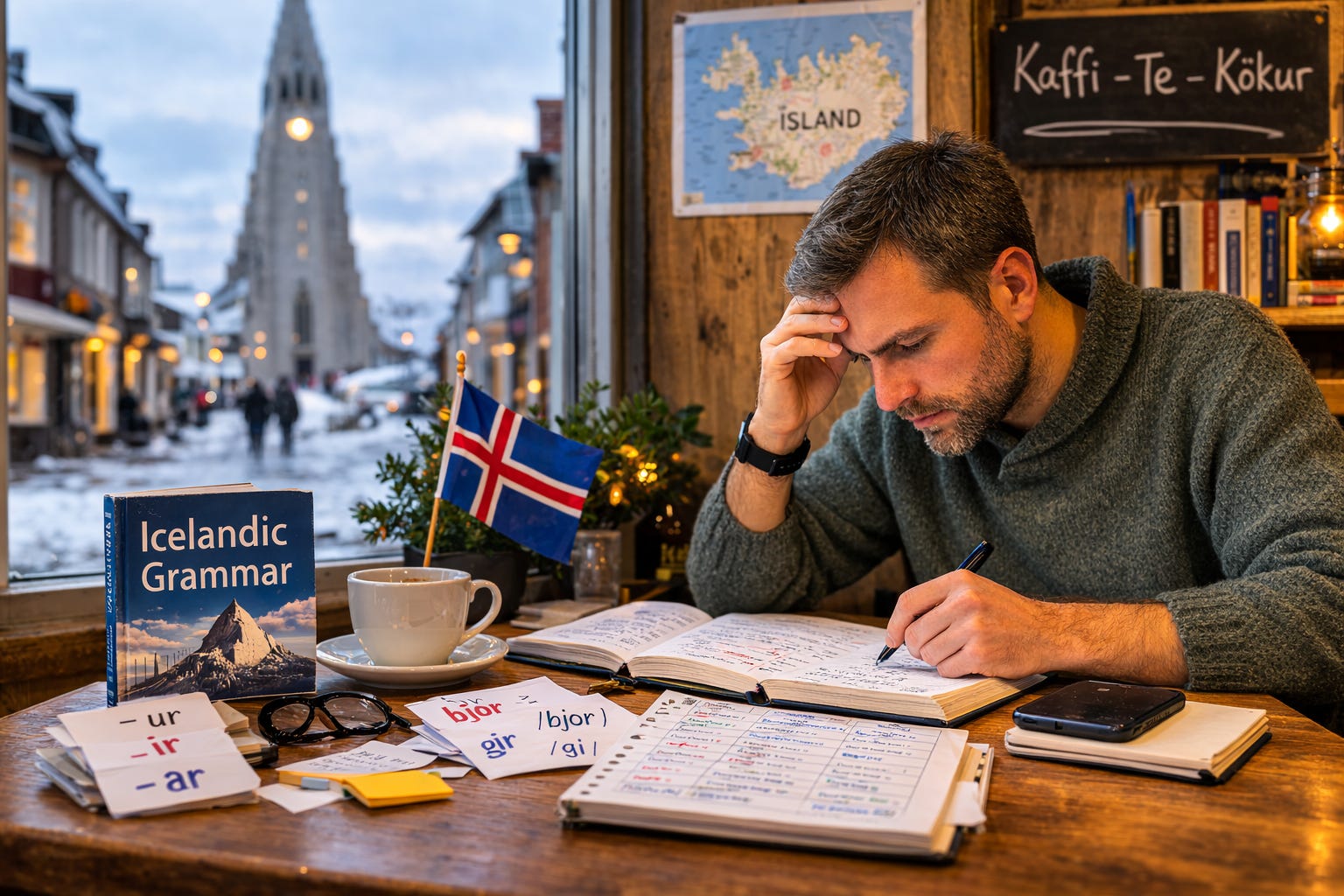
One of the most common questions people ask about Icelandic is whether it is a “difficult language.” The short answer, almost universally given by learners, is yes. Yet the more interesting answer is that the question itself is somewhat misleading. Linguistically speaking, the difficulty of a language is always relative to the linguistic background of the learner. Everyone knows this (I think!).
Languages are not learned in a vacuum. The structures, sounds, and patterns that a person already knows from their native language inevitably shape how easy or difficult another language will feel. The closer two languages are historically and structurally, the easier it will generally be for speakers of one to learn the other. Italian speakers, for example, tend to find English morphology very straightforward: verbs hardly change, nouns do not decline, and grammatical gender plays no role. An enormous amount of English vocabulary is Latin-based, which makes thousands of words immediately recognisable: an Italian will instinctively understand what vicissitudes, magnanimity, obfuscate, moribund or recondite mean. After all, they are not far from vicissitudini, magnanimità, offuscare, moribondo and recondito. Yet, these are words that even native speakers may not be familiar with!
For Japanese learners, by contrast, the situation is quite different. Not only will most vocabulary be totally obscure, but English word order, articles, plural marking, and other grammatical features that Europeans take for granted can pose considerable difficulty. As an Italian, I find Icelandic phonology quite unproblematic, but for English or German speakers, those rolled r’s that are fundamental to distinguish singular and plurals can be very tough. In that sense, no language is inherently easy or difficult. What matters is distance.
And yet, when it comes to Icelandic, there is an interesting phenomenon. While linguists rightly insist on the relativity of language difficulty, anecdotal experience is so consistent that it cannot simply be dismissed as subjective impression. It is remarkably difficult to find anyone who reports that learning Icelandic is easy. Perhaps a speaker of Faroese might say so, I am not sure, but there are very few of them. Everyone else, regardless of their linguistic background, tends to describe the experience in similar terms: very demanding.
As a teacher of Icelandic grammar at the university of Iceland, I often get students that are PhD candidates or even post-doctoral researchers in disciplines such as physics or maths claiming that they do not find their discipline as demanding as Icelandic. And no, I do not find that flattering!
To understand why, one must first recognise a basic linguistic truth: all languages are equally complex if one aims to master them at a high level. Reaching a level comparable to that of an educated native speaker always involves grappling with a vast system of subtle rules, conventions, and stylistic nuances. Not to mention exceptions, idiomatic usage and idiosyncrasies that apparently make no sense.
Take English, which is widely regarded as an “easy language.” In many respects it is indeed accessible. Its morphology is extremely poor: verbs barely inflect, nouns do not decline, and grammatical gender has disappeared. For basic communication, the learner can operate with a minimal amount of grammar. Once you learnt an English word, whether it is a noun or a verb, then you know it and can use it. Save for the few irregular plurals such as mice or feet, and verbs such as eat/ate/eaten, once you learn a new English word, you can in principle use it whenever you want.
However, this apparent simplicity conceals many layers of complexity. Consider, for example, the ordering of adjectives. Native speakers instinctively know that one says “a beautiful small old stone house,” but not “a stone old small beautiful house.” The rules governing this order are highly systematic, but they are rarely taught explicitly, and many second-language speakers never fully master them, even after decades of using English. Native speakers immediately perceive when the order is wrong, but explaining why it is wrong is another matter entirely. Mastering this order as a second language learner, if not impossible, is certainly very hard and in no way easier than mastering an Icelandic verbal paradigm.
Italian provides a different illustration. Its overall structure may appear relatively approachable to speakers of other European languages, but learners often struggle for years with clitic pronouns and the subtleties of verbal tenses and moods. Choosing correctly between li, gli, ne, ci, or combining them in forms like glielo or me ne, can remain a persistent source of difficulty even for advanced speakers.
Yet in both English and Italian it is perfectly possible to function in everyday life with only a partial mastery of the language. A person who needs only to order food, ask for directions, or conduct simple transactions can learn enough relatively quickly. The grammar that remains unmastered may affect elegance and precision, but it rarely prevents basic communication.
This is where Icelandic differs: in Icelandic, some of the most complex features of the language appear immediately at the beginner level. Unlike English or Italian, where one can postpone many of the most intricate aspects of the language until later, or even ignore them altogether, Icelandic places some of them directly at the entrance.
Even ordering a glass of wine and food at a restaurant requires navigating grammatical cases. Nouns decline in four cases. Adjectives must agree with them. Articles behave differently depending on context. The form of a word may change according to its syntactic role in the sentence. These are not advanced stylistic refinements: they are part of the everyday mechanics of the language.
For learners coming from languages with little or no inflection, this can be striking. It creates the impression that Icelandic demands a level of grammatical awareness from the very beginning that other languages allow one to postpone indefinitely.
Interestingly, not all aspects of Icelandic are particularly difficult for foreign learners. Word formation and specialised vocabulary, for instance, are typically more transparent than in English. English vocabulary is famously heterogeneous. Its roots and derivational systems combine elements from Germanic, Latin, French, and Greek sources. As a result, derivation can be unpredictable. Knowing the everyday word tooth does not necessarily help one understand what a dentist does, because the latter word uses the Latin root dent- rather than the Germanic root found in tooth. The learner must memorise many such connections individually. Icelandic tann- (the root for tooth) and læknir (‘doctor’) make up the word tannlæknir, whose meaning will be obvious to anyone knowing the word for tooth and that for doctor.
English phonology is significantly more complex than Icelandic phonology: the former displays around 24 consonant phonemes and 20–25 vowel phonemes in Received Pronunciation (the total is around 50), the latter displays a set of around 20 consonant phonemes and 8 vowel phones (so around 30 total).
Equally, in English as much as in Italian, word stress is distinctive. If in Icelandic you can more or less trust that the primary stress will be on the first syllable of any given word, you are in for many surprises with Italian or English, in which words changes meaning depending on what syllable carries the stress: an OBject has the stress on the first syllable, can you obJECT to that? What about a REcord that you need to reCORD? Or a DEsert that people must deSERT? You get the idea.
Icelandic tends to be far more internally consistent. Its vocabulary relies heavily on native roots and productive compounding. Once one has acquired a basic familiarity with the language, it becomes surprisingly easy to interpret complex or specialised terms. Scientific or technical vocabulary is often constructed from transparent components that can be intuitively understood and is accessible even to non-specialist. Paradoxically, then, some advanced lexical domains in Icelandic may feel clearer than comparable areas in English.
The real challenge lies elsewhere: in the grammatical infrastructure that governs even the most ordinary utterances. To say simple things correctly, the learner must become comfortable with concepts such as case assignment, agreement, and a number of derivational patterns that influence how words behave in sentences.
This does not mean that Icelandic is objectively more difficult than other languages. Rather, it means that Icelandic does not allow the learner to acquire only a few superficial elements and rely on them indefinitely for basic communication. The language requires engagement with its structure early on.
In English or Italian, one can learn a limited set of tools and manage reasonably well for everyday purposes while ignoring many of the deeper complexities. In Icelandic, some of those complexities are simply unavoidable.
At the same time, Icelandic rewards effort in an unusual way. Many aspects of the language that initially appear intimidating gradually reveal themselves to be remarkably systematic and elegant. Once the underlying patterns become familiar, learners often discover that certain areas of vocabulary and word formation are more predicable than they expected.
The apparent difficulty of Icelandic therefore stems less from intrinsic complexity than from the way that complexity is distributed. The language places some of its structural demands at the very beginning, where learners encounter them immediately.
In other words, Icelandic does not prevent you from learning many things easily. It simply asks you to learn some of the difficult things before you can get away with the easy ones.
So interesting! I speak Italian fairly well - well enough to survive and travel - and I learned it very quickly because I already spoke French and Spanish.
I’ve been improving my Japanese on and off for twenty years (I worked in Japan from 2006 to 2008) and it’s easier than people may think. I used to teach English as a foreign language and found out from my Korean students how quickly they learned Japanese, which backs up your point about one’s original language.
Icelandic? I’m determined to learn a little. It would be great to at least understand the (modern) written language when I visit.