

Learning Icelandic in Iceland: Why the System Is Not Working

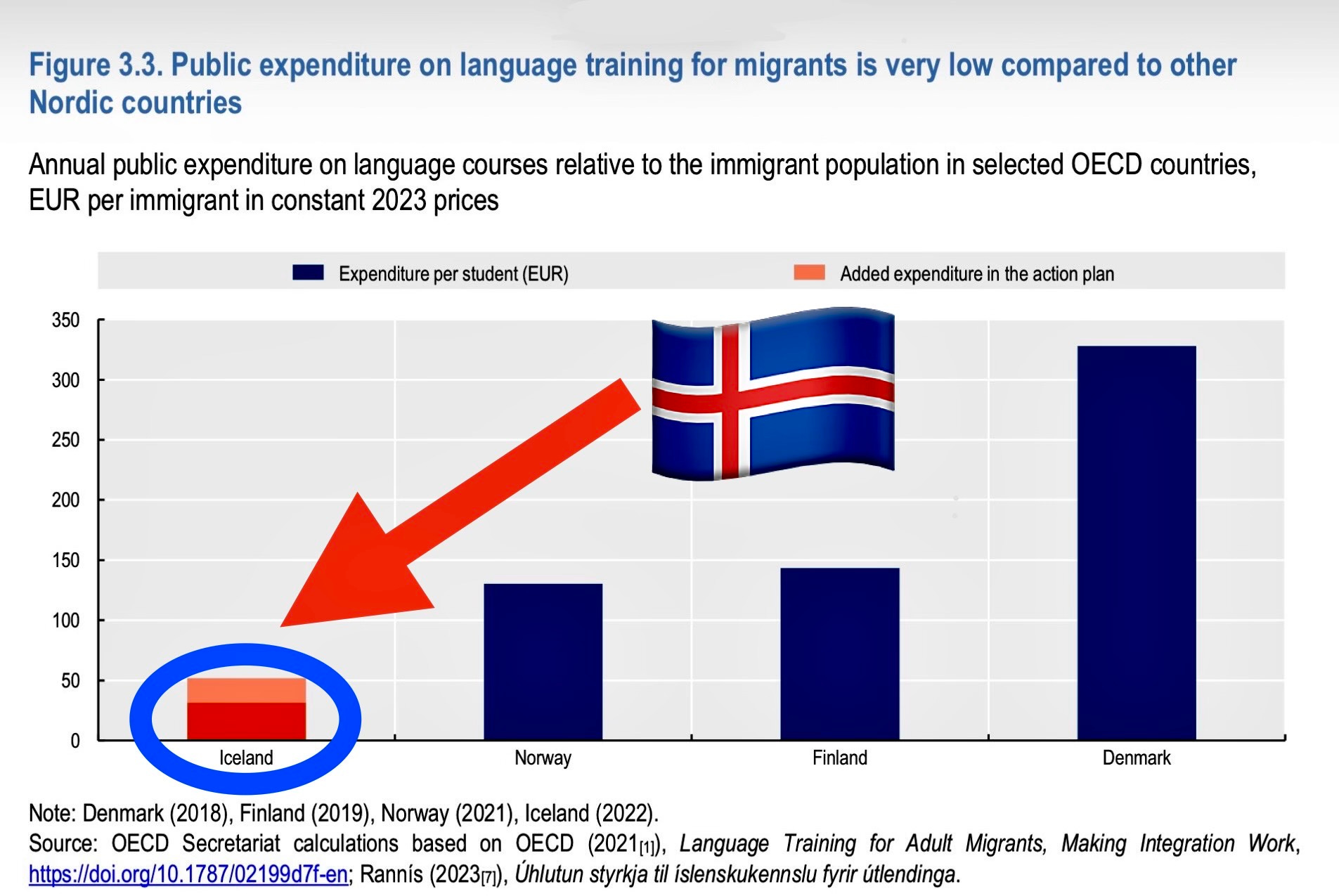
A serious wake-up call about learning Icelandic: the OECD report on the integration of immigrants in Iceland contains data that should give us serious pause for thought.
Over the past ten years, Iceland has experienced the fastest relative growth in immigration among OECD countries. However, integration policies have not kept pace with this demographic transformation. The consequences are particularly visible in the data on language proficiency.
According to the report, only about 18% of immigrants in Iceland report having advanced proficiency in Icelandic, compared to roughly 60% on average across other OECD countries. This is the lowest level of host-country language proficiency recorded in the entire OECD.
The report also makes it clear that this is not simply a matter of individual effort. Structural conditions in Iceland differ significantly from those in other Nordic countries. Nor is the issue the language itself. If one points to the morphological (what people commonly call “grammatical”) complexity of Icelandic, it is worth remembering that Slavic languages have even more complex morphology, yet immigrants in those countries do not show the same linguistic difficulties. The problem lies elsewhere.
In particular, public investment in language training is much lower than in other Nordic countries, and fully subsidised courses are generally limited to refugees or the unemployed. Most migrants therefore have to pay for language courses out of pocket. These typically cost around 52,000 Icelandic krónur for just 40–60 hours of instruction. Trade unions may reimburse these costs, but for many people in financially fragile situations, paying the fee in advance is simply not possible.
As a result, most immigrants receive very little formal language training. Only one in five has taken more than three courses, meaning that many have received less than 200 hours of total instruction. The consequences are profound.
Nearly half of immigrants who struggle to find employment identify insufficient knowledge of Icelandic as the main reason. Language proficiency also plays a decisive role in the ability to work in occupations consistent with one’s level of education and in the risk of experiencing discrimination.
The effects extend to the next generation as well. Among students born in Iceland to immigrant parents, more than half achieve very low scores in PISA reading tests, and language plays a crucial role in this gap. In other words, this is not merely a linguistic issue. It is a matter of labour-market integration, equality of opportunity, and social cohesion.
If Iceland wants immigrants to learn Icelandic so that it remains the main language of communication in this country, it must recognise a simple reality: making the foreign population learn the language requires serious public investment. But that alone is not enough. A serious public debate is also needed in order to organise a coordinated effort across society as a whole. The problems are numerous, and not all of them can be solved with funding alone:
There are too few teachers.
Some teachers are not adequately qualified.
Courses outside specialized university programmes are often poorly balanced, offering either too much grammar or too little.
Teaching materials are scarce or outdated.
Society is not accustomed to interacting with non-native speakers.
Icelanders often switch to broken English as soon as they notice grammatical or pronunciation uncertainty.
Some sectors, such as tourism and services, offer too few opportunities to practice the language.
The mental energy required to begin learning Icelandic is simply too great for people who are economically fragile and exhausted by work.
Unlike some other languages, Icelandic does not easily allow learners to acquire basic “survival” competence in a short time.
It requires a greater effort at the beginning and less intense effort later on—the exact opposite of what happens with languages such as English or Italian.
Some Icelandic employers—whether out of laziness, ignorance, or self-interest—are unwilling to sacrifice time or resources to accommodate their employees’ need to learn the language. They often prefer that everyone simply speak English and leave it at that.
In other Nordic countries, language training is considered one of the central pillars of integration policy. In Iceland, by contrast, it is still largely treated as an individual responsibility. The gap is clearly visible in the data.
If we want a society in which everyone can participate fully—economically, culturally, and democratically—then investing far more in the teaching of Icelandic is a necessity.
As an immigrant in Iceland, I see this daily. Not only in my own day-to-day but among my friends who are also apart of the immigrant community. There isn’t a lack of effort to learn — despite what Icelanders say — there’s a lack of sufficient resources to help us not only learn, but put learning into practice.
Thank you for your article!